The Mura Journal
What Is a Bustle? Turning Your Train Up for the Reception
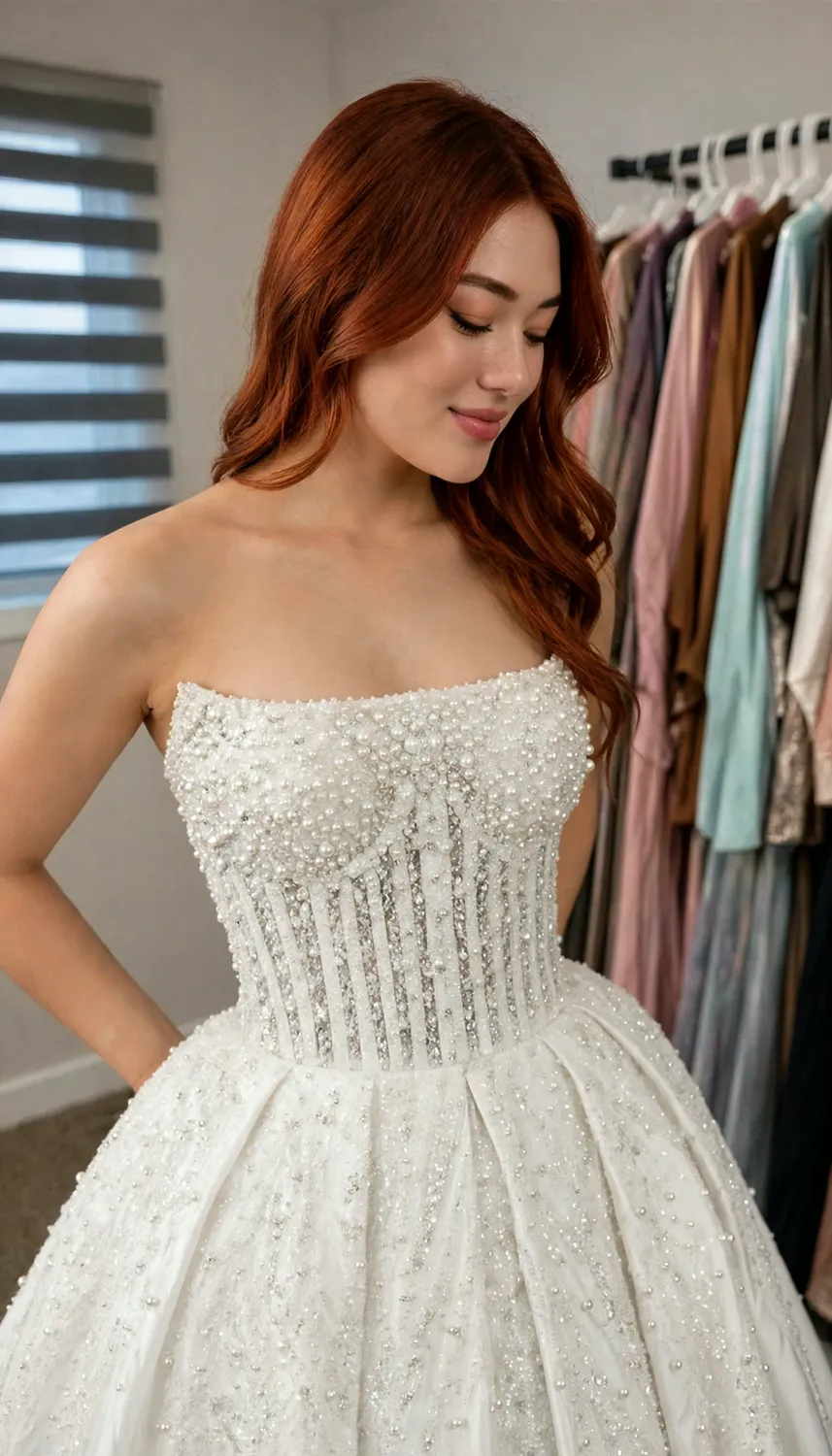
Every bride with a train needs a bustle — and almost no bride knows what one is until someone explains it, usually too late. A bustle is the system of buttons, loops, hooks, or ribbons that lifts your train up and secures it to the back of your dress after the ceremony, so you can walk, mingle, and dance without two metres of fabric following you into every conversation. Here is how bustles work, in plain language.
Why a bustle exists
A train is designed for exactly one activity: processing slowly down an aisle and being photographed. It is not designed for a receiving line, a buffet, or a dance floor, where it would be stepped on (by you, your partner, and every enthusiastic guest), dragged through spills, and generally stressed at its seams. The bustle is the train's second configuration — the dress's party mode. A good bustle keeps the lifted fabric looking like a deliberate design feature, not a bundle.
The main bustle styles
- American (over) bustle — the train is lifted and hooked or buttoned onto the outside back of the dress, creating soft folds or a waterfall effect over the skirt. Visible, pretty, and the most common choice for ballgowns and A-lines.
- French (under) bustle — ribbons sewn inside the skirt tie together, tucking the train up underneath so the outside silhouette stays smooth and uninterrupted. Elegant on fitted and minimalist gowns.
- Ballroom bustle — multiple points lift the train so completely that the dress appears to have no train at all, falling evenly to the floor all around.
- Wrist loop — the simplest option: a loop at the train's end that slips over your wrist or finger. Lovely for photos and short distances, tiring for a whole evening — best as a supplement, not the plan.
Who bustles your dress, and when
Traditionally: your maid of honour, a bridesmaid, or your planner, right after the ceremony or portraits. The important part is rehearsal. Bustling an unfamiliar dress under time pressure, in a hallway, with an audience, is a small wedding-day stress that is entirely avoidable. Designate your bustle person, and have them practise once — at the final try-on is ideal. If your dress is custom-made with us, we will show you and your person exactly where every button and loop lives before the big day; that walkthrough is part of our custom process. Take a phone video of the practise run. Future you, at 6 p.m. on the wedding day, will be grateful.
Built in, not bolted on
A bustle works best when it is planned with the dress. The number and placement of bustle points depend on the train's length and weight — a cathedral train needs a stronger, multi-point plan than a chapel sweep (see our train comparison for lengths). When your gown is made to your exact measurements, the bustle points are positioned for your dress's actual construction and your height, and reinforced so they hold through a night of dancing. If you are still deciding whether you want a train at all, our article on train-free dresses covers the alternative.
Questions about trains, bustles, or any other dress mechanics? Book a private try-on at Mura Boutique in Martindale NE, Calgary — we love the practical questions as much as the pretty ones. Most custom dresses take about 4–6 weeks to make. Call or text (587) 434-7634 to book your appointment.